

KENLEE’S LAW: A Bold New Bill to Protect Florida Children and Families from Overreach
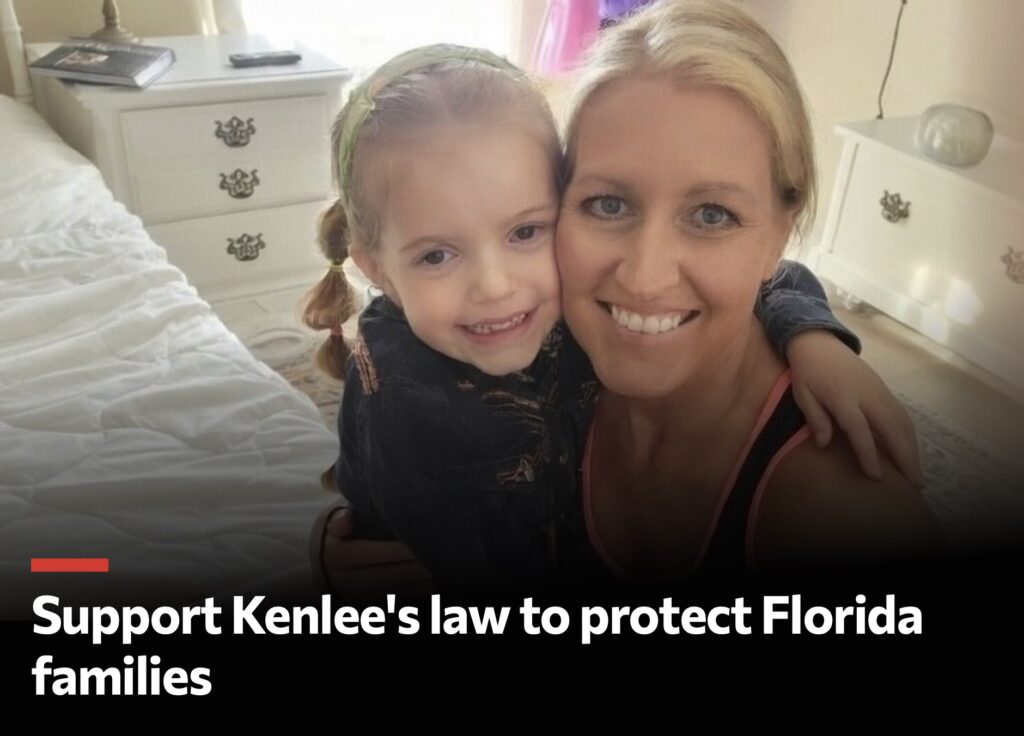
Kenlee Zuraff’s story has touched the hearts of countless Floridians and exposed serious problems in how the Department of Children and Families (DCF) handles child protective investigations. In response, we propose KENLEE’S LAW to the Florida Legislature to bring much-needed transparency, accountability, and fairness to the child welfare system.
This common-sense reform aims to protect children by keeping families together whenever it is safe to do so, while ensuring that when removals do occur, they are handled fairly and with proper oversight.
Sign the Change.org petition to show the Florida legislature how important this law is for families.
https://www.change.org/kenleeslaw
What KENLEE’S LAW Would Do
Here is a clear summary of the key provisions:
- Body-Worn Cameras for DCF Workers
All DCF employees, contractors, and agents would be required to wear and activate body cameras during home visits, investigations, child removals, and in-person family interactions. Recordings would be kept for at least 5 years and made available to families and courts, creating an unbiased record of what actually happens. - Recording Rights for Families
The bill updates Florida’s wiretapping law so that parents, family members, and observers can legally record interactions with doctors, nurses, DCF workers, and other public officials without needing everyone’s consent. This change applies retroactively for the past 12 years and provides full immunity for past good-faith recordings. - Keeping Children Close to Home
Unless a judge finds clear and convincing evidence it is not in the child’s best interest, children removed from their homes could not be placed in foster care more than 30 miles away from their original residence. The bill also prioritizes placement with relatives (kinship care) to preserve family bonds. - Stronger Accountability for False Statements
Qualified immunity would be removed for anyone — including DCF workers, judges, or medical professionals — who knowingly makes false statements or commits perjury in child welfare cases. Medical doctors, nurses, or hospital administrators found by a court to have provided materially false information would face immediate probation and investigation by the State Surgeon General. - Public Transparency Through Statistics
Hospitals, doctors, and nurses would have to publicly post simple, de-identified annual statistics on how many child abuse reports they file with DCF.
DCF itself would publish clear statewide and regional statistics each year on how many children are removed, how many are reunified with their families, and how many end up in permanent state custody. - Open Courtrooms and Limited Gag Orders
Judges in dependency cases would generally not be allowed to issue broad gag orders or close hearings to the public, except in narrow cases involving sexual abuse where a child’s safety requires it. This promotes public trust and allows families and advocates to speak more freely about systemic issues. - Parental Legal Assistance Fund
Fifty percent of the federal Title IV-E funds received by DCF would be dedicated to a new “Parental Legal Assistance Fund.” This money would help parents afford quality, independent legal representation in dependency and termination cases — leveling the playing field so families are not overwhelmed by state resources.
Additional supports would include legal aid referrals, independent advocates, and counseling services for families facing removal proceedings.
How KENLEE’S LAW Helps Children in Florida
Children do best when they are safe and loved by their own families. Too often, well-intentioned systems remove children unnecessarily or place them far from home, causing trauma and breaking family ties. KENLEE’S LAW helps Florida children by:
- Creating an honest record of interactions so decisions are based on facts, not he-said-she-said.
- Discouraging false or exaggerated reports that lead to wrongful removals.
- Keeping kids closer to their parents, siblings, schools, and communities when removal is unavoidable.
- Encouraging faster and safer reunifications through better oversight and parental legal support.
- Shining a light on the system with public data so policymakers and citizens can see what is really happening and push for continuous improvement.
The ultimate goal is fewer unnecessary family separations and better outcomes for children who truly need protection.
Politicians like Republican candidate for Florida Governor Rachel Rodriguez endorsed the law stating:
“Kenlee’s law is a move in the right direction toward First Principles in policy affecting families in Florida. The State does not give individual rights to parents and their children; therefore, it cannot take them away under cloak of medical and judicial authority. Florida families do not give their consent to be governed by unelected state agencies, nor do they give consent to our elected judges to rule against their individual rights protected by our state and federal constitutions. This proposed bill Reclaims Parental Rights and Reforms Court processes through transparency and disclosure, as well as providing aid and relief to parents needing the resources to defend their rights and protect their children.” – Rachel Rodriguez
A National Movement: The Save America’s Children Act
What is happening in Florida is part of a growing national effort to reform child welfare. A federal version of this legislation, called the Save America’s Children Act, is currently in development. This national bill seeks to bring similar transparency, accountability, recording rights, and family protections to child welfare systems across the entire country.Together, KENLEE’S LAW in Florida and the Save America’s Children Act at the federal level represent a powerful push to put parents and children first while still protecting kids who are truly in danger.
Join the Fight for Kenlee and Every Florida Child
KENLEE’S LAW is named in honor of Kenlee Zuraff and all the children caught in a system that sometimes loses sight of the families it was meant to help. If you believe children belong with their loving families whenever possible, and that government agencies must operate with honesty and transparency, we need your support.Share this article, contact your Florida state legislators, and stay involved at FreeKenlee.com.
Together, we can make Florida a national leader in protecting both children and parental rights.
KENLEE’S LAW
An act relating to child protective investigations; recording requirements; consent for recordings; placement of children in foster care; resources for affected families; perjury in child welfare proceedings; qualified immunity; disciplinary actions against health care professionals; public disclosure of child abuse reporting statistics by health care providers; public disclosure of Department of Children and Families child removal and permanency statistics; restrictions on gag or protective orders in dependency proceedings; and establishment of a parental legal assistance fund from Title IV-E federal funds; creating s. 39.XXXX, F.S.; amending s. 934.03, F.S.; providing a short title; providing findings and purpose; requiring body-worn cameras for certain Department of Children and Families (DCF) personnel during interactions; providing exceptions and procedures; revising two-party consent requirements under wiretapping laws to exclude certain professionals and public sector workers; providing retroactive application and immunity for certain recordings; providing additional resources and supports for families involved in child removals; establishing placement safeguards for children in foster care; removing qualified immunity for certain officials in cases involving perjury or false statements in child welfare proceedings; requiring immediate probation and investigation by the Surgeon General for medical doctors, nurses, or administrators providing materially false information in child welfare proceedings; requiring hospitals, medical offices, and licensed health care professionals to publicly disclose de-identified statistics on reports to the Department of Children and Families; requiring the Department of Children and Families to publicly disclose annual statistics on child removals, reunifications, and permanent state custody outcomes; prohibiting judges from issuing gag or protective orders in dependency proceedings except in limited circumstances involving sexual abuse; establishing a Parental Legal Assistance Fund using 50 percent of federal Title IV-E funds received by DCF to support parents’ legal representation in child welfare proceedings; providing applicability; providing effective dates.
Be It Enacted by the Legislature of the State of Florida:
Section 1. This act may be cited as “KENLEE’S LAW.”
Section 2. The Legislature finds that transparency, accountability, and the protection of parental rights and child welfare are essential interests and obligations of the State through the Department of Children and Families (DCF). Cases involving child removals, including those stemming from medical treatment disputes, have highlighted concerns regarding parental-agency interactions and operations in dependency proceedings. This act seeks to address these issues by mandating body-worn cameras for DCF personnel, modifying consent laws for recordings, providing retroactive protections, enhancing family supports, imposing proximity requirements for foster placements, ensuring accountability for perjury by removing qualified immunity protections, imposing immediate disciplinary measures on health care professionals who provide materially false information, requiring public disclosure of de-identified statistics on reports of suspected child abuse by medical providers and on DCF child removal and permanency outcomes, limiting gag or protective orders in dependency proceedings to promote public trust and informed reform while protecting victims in sexual abuse cases, and allocating 50 percent of federal Title IV-E funds received by DCF to a dedicated fund to ensure parents have access to quality legal representation for a fair and balanced system in child welfare courts.
Section 3. Section 39.XXXX, Florida Statutes, is created to read:
39.XXXX Body-worn cameras for DCF personnel; required use during interactions.—
(1) All DCF employees, contractors, and agents conducting protective investigations, home visits, child removals, or any in-person interactions with families or children under chapter 39 must wear and activate body-worn cameras during such interactions, in a manner consistent with use by law enforcement officers.
(2) The cameras must record audio and video continuously throughout the interaction, subject to privacy protections as defined by department rule or applicable law, including s. 39.202.
(3) Recordings shall be retained for a minimum of 5 years, or longer if subject to a litigation hold upon written notice of a proposed or pending lawsuit, including criminal investigations. Recordings shall be made available to involved parties, courts, or oversight entities upon request, subject to confidentiality protections under s. 39.202.
(4) The department shall adopt rules to implement this section, including training, equipment standards, activation protocols, and data storage.
Section 4. Subsection (2) of section 934.03, Florida Statutes, is amended to add the following exception:
In addition to existing exceptions, it is not a violation of this section for any person to intercept or record a wire, oral, or electronic communication without the consent of all parties if the communication involves:
(a) Any nurse, doctor, medical professional, or health care provider acting in their professional capacity; or
(b) Any public sector worker, including but not limited to employees, agents, or contractors of the Department of Children and Families, law enforcement, courts, or other state agencies acting in their official capacity.
Such recordings may be made by any participant or observer and used for purposes of admissible evidence, formal and informal reporting, and/or protecting individual and parental rights, without criminal or civil liability under this chapter.
Section 5. Retroactive application and immunity.—
The amendments to s. 934.03, F.S., made by this act shall apply retroactively to recordings made in the 12 years preceding the effective date of this act.
Any person possessing or disclosing a recording that would have violated s. 934.03, F.S., prior to this act’s effective date, but which falls under the exceptions added by this act, is granted immediate and full immunity from prosecution, civil liability, or other penalties related to the recording’s creation, possession, or disclosure, based solely on the date of its recording.
Section 6. Additional resources for families.—
The Department of Children and Families shall establish and fund programs providing:
(1) Legal aid referrals and financial assistance for families subject to child removal proceedings;
(2) Independent advocacy services during investigations; and
(3) Counseling and support services for parents and children affected by removals.
Section 7. Foster care placement safeguards.—
In any removal under chapter 39, unless the court finds clear and convincing evidence that it is not in the child’s best interest, a child shall not be placed in foster care more than 30 miles from the child’s customary and last place of residence prior to removal. The identification of the customary and last place of residence shall be determined at the probable cause hearing by a preponderance of the evidence. If the child has more than one customary and last place of residence due to time-sharing arrangements, this section shall apply to the residence or residences within the jurisdiction of the court having jurisdiction over the removal proceeding. The department shall prioritize kinship placements and maintain proximity to preserve family connections.
Section 8. Removal of qualified immunity for perjury and false statements.—
Notwithstanding any other provision of law, qualified immunity shall not apply to any person, including judges, DCF employees, medical professionals, or other officials, who knowingly provides false information, commits perjury, or submits materially false statements in any affidavit, report, or testimony in a proceeding under chapter 39. Such individuals shall be subject to criminal prosecution under s. 837.02 (perjury in official proceedings) or other applicable laws, and to civil liability without immunity defenses.
Section 9. Immediate probation and investigation for health care professionals providing materially false information.—
Any medical doctor, nurse, or hospital or medical facility administrator licensed under chapter 458, chapter 464, or other applicable provisions, who is found by a court in a proceeding under chapter 39 to have knowingly provided materially false statements in any affidavit, report, testimony, medical record, or other submission to the court, the Department of Children and Families, or to any party in a child protective investigation or dependency case shall be immediately placed on probation by the Department of Health, pending a full investigation.
The probation shall commence upon the court’s finding or notification to the Department of Health and shall continue until the investigation is complete and a final determination is made by the appropriate board (e.g., Board of Medicine or Board of Nursing).
The investigation shall be conducted under the jurisdiction and direct oversight of the State Surgeon General or the Surgeon General’s designee, who shall ensure expedited review and coordination with the relevant professional board.
This section supplements, and does not limit, existing grounds for disciplinary action under s. 456.072, s. 458.331, s. 464.018, or other applicable statutes, including making or filing false reports or representations.
Section 10. Public disclosure of statistics on reports to the Department of Children and Families by health care providers.—
Each licensed medical doctor (under ch. 458 or 459), nurse (under ch. 464), medical office, hospital, and hospital system shall annually compile and publicly disclose on a publicly available website (such as the facility’s site or a centralized portal maintained by the Department of Health or Agency for Health Care Administration) de-identified aggregate statistics relating to reports of suspected child abuse, abandonment, or neglect made by its staff to the Department of Children and Families central abuse hotline under s. 39.201.
The required statistics shall include, for each calendar year:
(1) For each individual medical doctor or nurse: The number of reports made by that individual.
(2) For each medical office or hospital/hospital system: The total number of reports made by all staff affiliated with the entity.
(3) Categorization of the types of complaints alleged in the reports, limited to: medical neglect or abuse, sexual abuse, or physical abuse (using de-identified aggregates only; no case details, child identifiers, or reporter names shall be disclosed).
Data shall be reported annually by March 31 for the prior calendar year, retained for at least 5 years, and presented in a clear, searchable format to facilitate public review.
The Department of Health, in consultation with the Agency for Health Care Administration and the Department of Children and Families, shall adopt rules to implement this section, including standards for de-identification to comply with s. 39.202 confidentiality requirements, HIPAA, and other privacy laws; data submission formats; and enforcement for noncompliance (e.g., administrative fines).
Disclosure under this section is limited to aggregate, anonymized statistics and does not authorize release of any confidential information from individual reports or records under chapter 39.
Section 11. Public disclosure of Department of Children and Families child removal and permanency statistics.—
The Department of Children and Families shall annually compile and publicly disclose on its official website or a centralized public portal de-identified aggregate statistics for each fiscal year relating to children involved in protective investigations and dependency proceedings under chapter 39.
The required statistics shall include, at a minimum:
(1) The total number of children taken into custody or removed from their homes (entries into out-of-home care) statewide and by circuit or region.
(2) The number and percentage of children returned to their families through reunification.
(3) The number and percentage of children permanently remanded to state custody with case custodial outcomes (e.g., through termination of parental rights leading to adoption, permanent guardianship, or other permanency outcomes not involving return to the biological family).
Data shall be reported annually by December 31 for the prior fiscal year, retained for at least 10 years, and presented in a clear, searchable format with breakdowns by circuit, community-based care lead agency, and demographic categories (where de-identifiable) to facilitate public review and oversight.
The department shall adopt rules to implement this section, including standards for de-identification to comply with s. 39.202 confidentiality requirements and other privacy laws.
Disclosure under this section is limited to aggregate, anonymized statistics and does not authorize release of any confidential case-specific information.
Section 12. Restrictions on confidentiality orders and protective orders in dependency proceedings.—
Notwithstanding any provision in chapter 39 or other law allowing courts to issue confidentiality orders, protective orders, or orders restricting public access or disclosure in dependency proceedings, a judge may not issue such an order except upon a finding by clear and convincing evidence that the order is narrowly tailored and necessary to protect the identity, safety, or well-being of a child or victim, specifically in cases involving allegations of sexual abuse.
In all other dependency proceedings under chapter 39, hearings shall remain open to the public to the extent consistent with existing law, and no order shall prohibit parties, participants, or the public from discussing or disclosing non-confidential aspects of the case, including general procedural information or aggregate outcomes.
This section supplements, and does not limit, existing confidentiality protections under ss. 39.0132 and 39.202, but prioritizes judicial transparency.
Section 13. Parental Legal Assistance Fund from Title IV-E federal funds.—
There is created within the Department of Children and Families the “Parental Legal Assistance Fund” to provide financial support for legal representation and related services to parents in dependency proceedings under chapter 39, ensuring a fair and balanced judicial process in child welfare courts.
Annually, 50 percent of any federal funds received by the Department of Children and Families under Title IV-E of the Social Security Act (including but not limited to funds for foster care maintenance payments, adoption assistance, guardianship assistance, prevention services, kinship navigator services, administrative costs, and training) shall be deposited into the Parental Legal Assistance Fund. This allocation shall occur upon receipt of such funds, prior to any other state reallocations or expenditures, subject to federal requirements and any necessary waivers or approvals from the U.S. Department of Health and Human Services.
Funds in the Parental Legal Assistance Fund shall be used exclusively to:
(1) Reimburse or directly pay for legal services, including attorney fees, expert witnesses, investigators, and court-related costs, for parents whose children have been removed or are subject to dependency or termination of parental rights proceedings; and/or
(2) Support parents at their discretion, with no requirement to use state-contracted or DCF-affiliated attorneys.
Access to the fund shall be simple and expeditious:
Parents may apply through an online portal, DCF regional offices, or community-based care lead agencies, with approval presumed unless clear evidence of ineligibility (e.g., non-involvement in a ch. 39 proceeding) exists.
Funds may be used for any licensed attorney or legal professional in the State of Florida, chosen by the parent.
Caps or limits on amounts per case shall be established by rule but must be sufficient to ensure meaningful representation (e.g., at least equivalent to prevailing rates for dependency counsel).
The department shall adopt rules to administer the fund, including application processes, eligibility verification, disbursement mechanisms, auditing, and annual public reporting on fund receipts, allocations, usage, and outcomes (e.g., impact on reunification rates or case resolutions).
This section supplements existing rights to counsel under s. 39.013, F.S., and federal allowances for Title IV-E administrative claims related to parental representation, but prioritizes state-level funding equity.
Section 14. Applicability.—This act applies to all proceedings and interactions initiated or ongoing on or after the effective date, with retroactive provisions as specified.
Section 15. Effective date.—This act shall take effect as soon as approved by legislative and executive offices.
